How Flatbed Towing Protects Your Transmission, Drivetrain, and Suspension
Not all tows are equal, and the difference can cost you a transmission. When a Calgary driver asks for a flatbed instead of a traditional hook, they are usually protecting the most expensive parts of their car. Here is exactly how carrying a vehicle beats dragging it.
The Problem With Wheels Left on the Ground
A conventional wheel-lift tow raises one axle and lets the other two wheels roll on the pavement. For many vehicles that is fine over short distances, but it means part of the drivetrain is still spinning without the engine running to circulate fluid or oil. That is where trouble starts for certain cars.
Why Your Transmission Is at Risk
An automatic transmission relies on its own pump, driven by the engine, to circulate cooling and lubricating fluid. Tow it with the drive wheels turning and the engine off, and those internal parts spin dry. Over enough distance this generates heat and wear that can lead to expensive failure. A flatbed removes the risk entirely by keeping every wheel off the ground.
The distance and speed of the tow make a real difference here. A quick lift across a parking lot with two wheels down rarely causes harm, but a highway-speed haul from Okotoks to a Calgary shop is another matter entirely, because the drivetrain spins fast and dry for far longer. Manual transmissions are somewhat more forgiving than automatics, yet they are not immune, and few drivers know their own gearbox’s tow limits off the top of their head. Rather than gamble on which category your car falls into, a flatbed simply removes the question by lifting every wheel off the road.
All-Wheel and Four-Wheel Drive Demand a Flatbed
AWD and 4WD systems link all four wheels through differentials and transfer cases. Dragging two wheels while the others sit can force these components to work against each other, causing serious internal damage. For these vehicles, common on Calgary and mountain-bound driveways, a flatbed is not a luxury but the correct method.
Protecting Suspension and Low-Clearance Cars
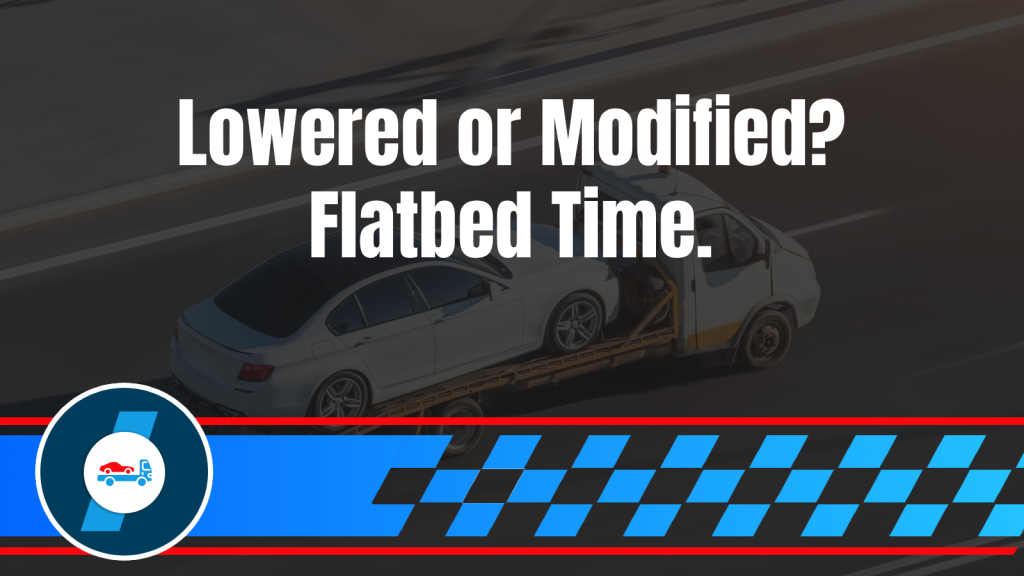
Flatbed towing also shields your suspension and body. Because the whole car is lifted and secured, there is no bouncing on a partially loaded axle and no scraping for lowered or performance vehicles. The benefits stack up:
- Zero drivetrain rotation, protecting transmission and differentials.
- No added strain on struts, control arms, or bushings during transport.
- Safe clearance for lowered cars, sports cars, and EVs.
- Secure loading for vehicles with flat tires or crash damage.
Electric Vehicles and Modern Cars
Most electric vehicles must be transported on a flatbed, because their motors are tied directly to the wheels and towing with wheels down can damage the drive units or regenerative systems. As EVs become common across Calgary, flatbed transport is increasingly the only safe option.
Beyond EVs, plenty of ordinary new cars now carry electronic parking brakes, adaptive suspension, or all-wheel-drive systems that dislike being towed with wheels turning. The owner’s manual usually spells out the correct method, but almost nobody reads that section until something goes wrong on the shoulder. As a rule of thumb, the newer and more sophisticated your vehicle, the stronger the case for a flatbed. When you call, tell us the year, make, and drivetrain so we arrive with the right equipment rather than discovering a complication once we are already on scene.
When a Flatbed Is the Smart Choice
If your vehicle is AWD, low to the ground, high value, electric, or already damaged, choose a flatbed without hesitation. The modest difference in cost is trivial next to a transmission or transfer case repair. When in doubt, ask the operator what your specific vehicle needs.
Need your vehicle carried, not dragged, anywhere near Calgary? Call Towing Calgary at (587) 330-2417. Learn more about our flatbed towing and everyday breakdown towing services.