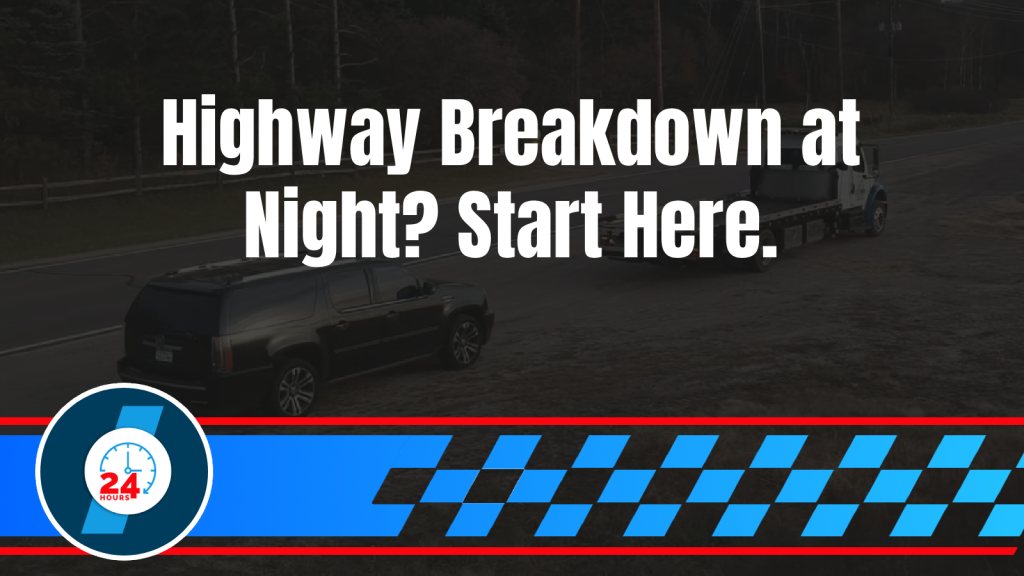
Broke Down on the Highway at Night? Your Step-by-Step Safety and Towing Guide
A breakdown on a dark Alberta highway is one of the most dangerous places a driver can find themselves. Traffic on Deerfoot, Stoney Trail, or the QEII toward Airdrie moves fast, and at night a stopped car is nearly invisible until the last second. These steps keep you safe while help is on the way, and the order you do them in matters.
Step 1: Get Off the Live Lane
The instant you sense trouble, signal and work your way to the right shoulder or an exit ramp, as far from moving traffic as you can manage. If you can coast to an off-ramp or a wide gravel margin, use it. Distance from the travel lane is your single best protection against a secondary collision.
If the car quits in a live lane and cannot be moved, that changes everything. Leave your seatbelt on, keep your hazards flashing, and call for help immediately rather than trying to push it across fast traffic.
Step 2: Signal and Light Up
Once stopped, put on your hazard lights right away and leave your headlights on so approaching drivers see you from farther back. Turning the front wheels away from the roadway is a smart habit in case the car is bumped from behind. The more warning you give fast-moving traffic, the more time other drivers have to move over.
If you carry reflective triangles or flares and can place them safely, set one well behind the vehicle to warn traffic before they reach you. Only do this if you can stay clear of the live lane the entire time.
Step 3: The Move-Over Reality on Alberta Highways
Deciding whether to stay in the car or get out is a different calculation on a highway than on a quiet street. At highway speed, everything happens faster and the margin for error shrinks.
- If you are hard against a barrier or on a narrow shoulder, stay buckled inside with the doors locked.
- If there is a wide shoulder or ditch and you can exit on the side away from traffic, move well back from the road and wait beyond the barrier or up the embankment.
- Never stand between your car and oncoming traffic, and never attempt repairs on the traffic side of the vehicle.
- Keep passengers, especially children, well away from the roadway while you wait.
Step 4: Call for Highway-Capable Towing
Give the dispatcher the highway name, your direction of travel, and the nearest exit, overpass, or marker so the truck finds you quickly in the dark. Mention clearly that you are on a high-speed roadway so the call gets the urgency it deserves. If a crash is involved or anyone is injured, call 911 first and let them coordinate.
Step 5: Positioning for the Tow Operator
When the truck arrives, follow the operator’s directions and stay well clear of the loading area on the traffic side. A highway recovery is done quickly and deliberately to limit everyone’s time next to fast traffic, so let the professional set the pace and load the car their way.
Have your details ready to speed the handoff. Knowing your exact location, keeping your keys within reach, and having any passengers already clear of the roadway lets the operator load quickly and get everyone moving off the shoulder with as little time in the danger zone as possible.
For fast, highway-ready help around Calgary, Airdrie, and along Highway 1, call (587) 330-2417. We handle emergency towing, accident towing, and winching and recovery at any hour of the night.