Does Your Vehicle Actually Need Flatbed Towing? AWD, 4WD, and When It’s Required
Not every vehicle can be safely towed with two wheels on the ground, and getting it wrong can mean thousands of dollars in drivetrain damage. For many Calgary drivers, especially the growing number in all-wheel-drive crossovers and four-wheel-drive trucks, a flatbed is not a luxury upgrade but the only correct way to move the vehicle. Here is how to tell what yours actually needs.
Why Drivetrain Type Decides the Method
When a vehicle is towed with its drive wheels rolling on the road, those wheels spin the transmission or transfer case even though the engine is off, and without the lubrication that normally protects them. On a conventional front- or rear-wheel-drive car, lifting the drive wheels off the ground solves this neatly. The complication arrives with vehicles that send power to all four wheels.
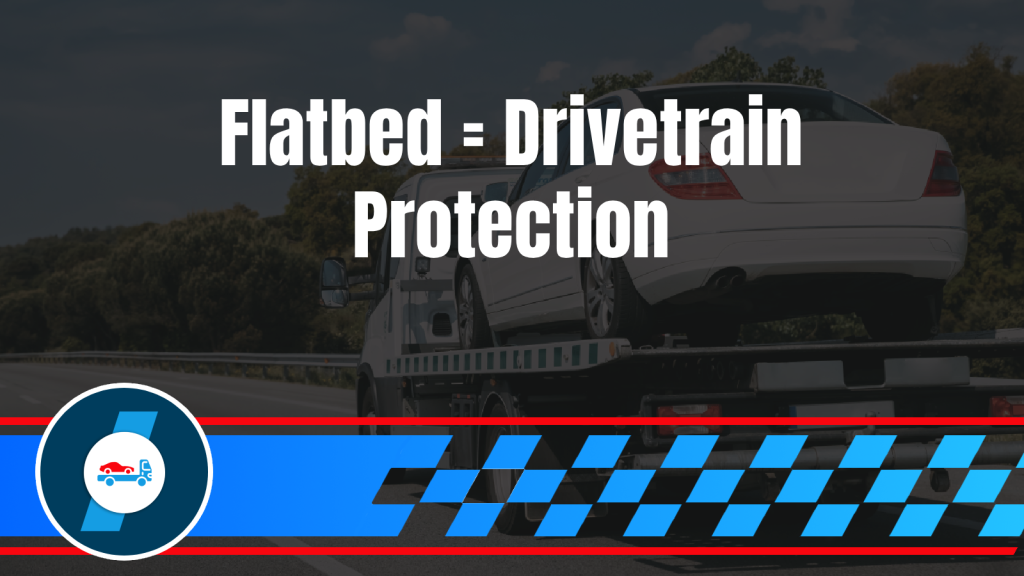
That is why the safest default for anything you are unsure about is a flatbed, where all four wheels sit still on the deck and nothing in the driveline turns during transport. It removes the risk entirely rather than relying on getting the details exactly right.
AWD and 4WD Vehicles
All-wheel-drive systems, common in the crossovers filling Calgary driveways, link all four wheels through a centre differential or coupling. Towing one with any wheels rolling can overheat and ruin those components. Four-wheel-drive trucks carry a transfer case with similar risks. Manufacturers of these vehicles almost universally specify flatbed transport, or all four wheels off the ground, right in the owner’s manual.
- All-wheel-drive crossovers and SUVs
- Four-wheel-drive pickups and off-road vehicles
- Performance cars with sensitive differentials
- Any vehicle the manufacturer explicitly says to flat-deck
Low, Luxury, and Modified Cars
Ground clearance is the other major factor. Lowered cars, sports cars, and many luxury vehicles have front lips and low bumpers that a conventional tow would scrape or crack. A flatbed with a shallow load angle lets these vehicles board gently. Classics and exotics belong on a flatbed too, simply to protect their value from any avoidable stress on the way.
Air suspension adds another wrinkle, since a vehicle resting in its parked position may sit with almost no clearance at all. Rather than risk a torn splitter on a steep ramp, a flatbed brings the loading surface close to level and lets the car ease aboard without scraping.
Non-Rolling and Damaged Vehicles
Any vehicle that will not roll, steer, or brake, whether from a seized wheel, a collision, or a locked transmission, needs a flatbed. Dragging a car with a flat-spotted or locked wheel destroys the tire and can gouge the pavement. After a crash, a flatbed keeps a compromised vehicle stable and prevents further damage on the trip to the shop.
This is also the safest choice when you simply do not know the vehicle’s condition. If a warning light, a strange noise, or accident damage leaves you unsure whether the wheels or transmission are compromised, a flatbed takes the guesswork out and eliminates any chance of towing damage.
When a Wheel-Lift Is Perfectly Fine
A flatbed is not always necessary, and a good operator will tell you so. A healthy front- or rear-wheel-drive vehicle can often be moved safely on a wheel-lift with the drive wheels raised, a practical and economical choice for shorter trips around Calgary and Airdrie. The key is matching the method to the vehicle rather than defaulting to the priciest option every time.
Distance matters as well. A short reposition across a parking lot is very different from a highway run to Red Deer, and what is fine for a few blocks may not be wise for a hundred kilometres. When in doubt, the extra care of a flatbed is cheap insurance against a transmission bill.
Not Sure Which You Need? Ask Us
When in doubt, describe your vehicle and we will recommend the right approach honestly. Call Towing Calgary at (587) 330-2417. Learn more about our flatbed towing and general breakdown towing services.